Les principales interventions au colloque «  La Coutume : formes, représentations et enjeux  » sont disponibles en ligne.
Articles les plus récents
-
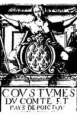
La Coutume : formes, représentations et enjeux
13 janvier 2009, par Mathieu Perona -

Comment enseigner la littérature du XVIe siècle ?
7 janvier 2009, par Blandine PeronaMatinée de réflexion et de discussion préparée par Jean-Raymond Fanlo et Daniel Martin, samedi 24 janvier 2009, Institut des Sciences de l’Homme, 14, av. Berthelot, Lyon.
-

The Ear & the Aural in Early Modern French Poetry.
6 January 2009, by PanurgeModern Language Association of America.
Annual Convention, Philadelphia, PA, 27-30 December 2009.
In Early Modern Europe, the printing press, the revered “ut pictura poiesis,†the Paragone, the vogue of emblems, and Neoplatonic thought – among other things – appear to have fostered a dominance of the eye, if not the supremacy of sight as the superior sense. Yet poetry remembers its formerly sung and mythically oracular nature, and struggles with its affinities with oratory. What (…) -

The Ear & the Aural in Early Modern French Poetry.
6 janvier 2009, par PanurgeModern Language Association of America.
Annual Convention, Philadelphia, PA, 27-30 December 2009.
In Early Modern Europe, the printing press, the revered “ut pictura poiesis,†the Paragone, the vogue of emblems, and Neoplatonic thought – among other things – appear to have fostered a dominance of the eye, if not the supremacy of sight as the superior sense. Yet poetry remembers its formerly sung and mythically oracular nature, and struggles with its affinities with oratory. What (…) -

Figures and figurations of power.
4 January 2009, by PanurgeIn De Re Publica Cicero founds the commonwealth on the people’s consent. By this definition, the crux of political action lies both on the necessary acceptance of power and on the means to obtain such acceptance. How can such compliance be expressed? How can it be established through a symbolic representation in the arts and the Belles lettres? From the 12th century in Portugal to the 16th century in France, the lay power was built in Europe in opposition to the religious power and was based (…)
-

Figures et figurations du pouvoir (5-6 novembre 2009).
4 janvier 2009, par PanurgeDans De la République, Cicéron définit la chose publique par l’adhésion du peuple aux lois ; ce faisant, il met au centre du discours politique le consentement au pouvoir ainsi que la capacité même pour celui-ci de susciter une forme d’assentiment. Comment l’adhésion se manifeste-t-elle ? Comment peut-elle être suscitée par la représentation symbolique du pouvoir dans les lettres et les arts ? Depuis le XIIe siècle au Portugal au XVIe siècle en France, le pouvoir laïc s’est (…)
-

"Dreams, Imagination, Fantasy."
4 janvier 2009, par PanurgePlymouth State University
30th Annual Medieval and Renaissance Forum
Friday and Saturday 24-25 April 2009.
What was the role of the imagination in Medieval and Early Modern culture ? Was “fantasy†distinguished from “reality†? How did people talk about and experience dreams ?
Papers need not be confined to the theme, but may cover many aspects of Medieval and Renaissance life, literature, languages, art, philosophy, theology, history and music. Student sessions welcome. (…) -

Dreams, Imagination, Fantasy.
4 January 2009, by PanurgePlymouth State University
30th Annual Medieval and Renaissance Forum
Friday and Saturday 24-25 April 2009.
What was the role of the imagination in Medieval and Early Modern culture? Was “fantasy†distinguished from “reality†? How did people talk about and experience dreams?
Papers need not be confined to the theme, but may cover many aspects of Medieval and Renaissance life, literature, languages, art, philosophy, theology, history and music. Student sessions welcome. (…) -
Amour divin, amour mondain dans les écrits du for privé de la fin du Moyen Age à 1914
16 décembre 2008, par Antoine RoulletCe colloque international, se tiendra les 4 et 5 juin 2010 à l’Université de Pau et des Pays de l’Adour. Il est organisé par Maurice Daumas (UPPA) pour ITEM (Identités, Territoires, Expressions, Mobilités, EA 3002) et Michel Braud (UPPA) pour le CRPHL (Centre de Recherche Poétique et Histoire Littéraire EA 3003).
Responsables scientifiques : Maurice Daumas et Philippe Loupès (Bordeaux 3) pour le volet historique ; Michel Braud et Philippe Lejeune (Paris-Nord) pour le volet (…) -

Mise à jour de la base de données bibliographiques GLN 15-16.
10 décembre 2008, par Guillaume BerthonLa base de données GLN 15-16 dont nous rappelions l’existence dans un article précédent a récemment été mise à jour. Désormais trilingue (français, anglais, allemand), elle contient davantage de fiches qu’auparavant (4731 au 8 décembre 2008) et atteint presque les 90% de notices écrites livre en mains.
Rappelons que GLN 15-16 est une base de données placée sous la responsabilité scientifique de Jean-François Gilmont, qui a pour objet la description de l’ensemble des livres (…)